Fall Fest: The Spider Room
This week the Discovery Room took on an exciting new look for Fall Fest week!
This week is ALL about SPIDERS!
The giant web and spider behind my seat was exciting and eye-catching for the kids!
We had an orb web on the floor for the children to sit on!
My goal this week was not only to educate the children about spiders but to have them leave my room with a new appreciation for what spiders do for us and how keeping them alive is very important not only for our environment but also for our own well-being.
We opened our Spider Week for the youngest scientists and kept things light and cheery. We started with a reading from one of my favorite books, Eric Carle's The Very Busy Spider. The children loved all the various animal voices incorporated into the story! We discussed why a web is important for a spider. It's for catching their food! We also learned not all spiders build webs. Only about half of all spiders build webs! We learned that spiders have EIGHT legs and many have up to eight eyes! They are arachnids, as are ticks and scorpions.

For those spiders that build webs, we talked about what kinds of webs we see and what sorts of "food" gets caught in them for the spider to eat (or remove). There are orb webs, funnel webs, sheet webs, tangle webs, and more! These webs can catch flies, mosquitoes, moths, butterflies, and any insect that gets caught in its grips. Each type of web spider spins a certain kind of web and it is a master at that type of web. Webs are beautiful. We saw pictures of all beautiful shapes and sizes of webs and they were in some interesting locations: trees, grass, barns, even on antlers!
For those spiders that do not build webs (including wolf spiders that we can find in Raleigh), they find other ways to catch their prey. Some hide and pounce, some create trap-door holes in the grounds, and others hide on walls or trees and capture their prey.
Example of trap door:
We learned that spiders eat so many insects that if we didn't have spiders, we would have WAY too many insects in our environments. This helps protect crops and the spread of disease from insects.
The children had a BALL putting (pretend) insects onto Miss Marion's sticky web! We learned that the spider will wrap the insects in silk and save them for later if they are not hungry at the time. We also learned that if they catch something they don't want, they'll safely remove it and drop it off the web! One last cool web fact: some spiders eat their webs for extra (silk) proteins!
The kids were fascinated with sitting on a web!
We talked about how strong webs are and that spiders release the silk from silk glands in their spinnerets. A spider can release different kinds of silk depending on what its needs are!
Each child got to go home with his/her very own spider and we agreed to leave spiders and their webs alone outside when it wasn't bothering us in any way. :)
For the 4's and 5's Fall Fest, I added a bit more of a spooky touch to the room especially with Halloween around the corner.
Above the orb web on the floor, I added a sheet web above the children's heads!
Lights off...
Lights on...
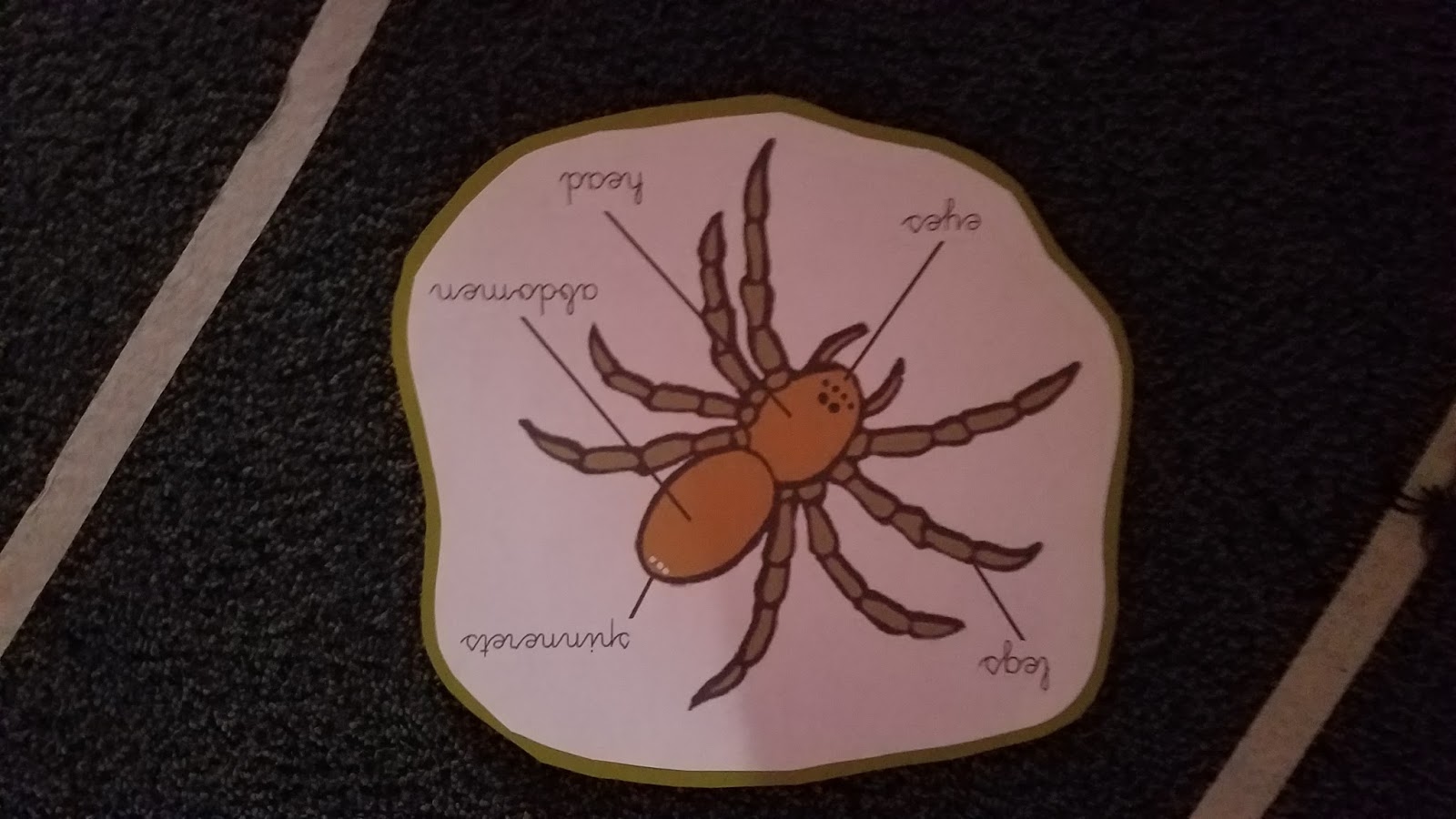
The older children learned the parts of the spider...
about the largest and smallest spiders...
About the spider's exoskeleton and how it will shed the exoskeleton as it grows...
We discussed how some spiders (wolf spiders) carry their young on their backs! (Web spiders will wrap their young in silk and often hang them in a sac near the web.)
We discussed that there are two spiders we have to avoid in North Carolina: the brown recluse and the black widow, but both are very shy and not commonly seen. To be extra safe, it's important to avoid putting our hands in dark, quiet areas without using a flashlight and gloves. We also learned that most spiders are completely harmless and just want to be left alone!
Spiders are special creatures.
Every child went home with a spider and got the opportunity to investigate the various spiders and prey (insects) set up throughout the room.
Hopefully, now everyone respects our eight-legged friends even more than we did before!
Several great spider books...
Think before you squash that spider. It's actually helping us. :)